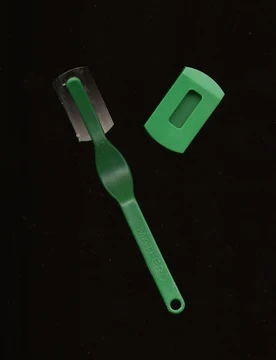
Mandoline
A manual slicer for uniform cuts with speed and precision.

A mandoline (US) or mandolin (British) is a culinary utensil used for slicing and for cutting juliennes; with suitable attachments, it can make crinkle-cuts. It consists of two parallel working surfaces, one of which may be adjustable in height, and is used by running food along an inclined plane into one or more blades.
- type
- Culinary utensil
- primary_use
- Slicing and cutting juliennes
- alternative_names
- Mandolin (British)
- key_feature
- Adjustable height for uniform thickness
- common_cuts
- Slices, juliennes, crinkle-cuts, waffle cuts, dice
- risk
- Can cause serious injury if not used correctly
Lore & Background
A mandoline consists of two parallel working surfaces, one of which may be adjustable in height. A food item is slid along the adjustable surface until it reaches a blade mounted on the fixed surface, slicing it and letting it fall. Other blades perpendicular to the main blade are often mounted so that the slice is cut into strips, allowing julienne cuts in one or more widths and thicknesses. With a mandoline, slices are uniform in thickness, which is important for foods that are deep-fried or baked, as well as for presentation. Slices can be made very quickly, with significantly less skill and effort than would be required if cutting with a knife or other blade, and adjustable mandolines can make very thin slices. A mandoline is used by running a piece of food (with some protection for fingers) along an adjustable inclined plane into one or more blades. On some models vertical blades cut to produce julienne, or a wavy blade is used that produces crinkle cuts. In these models a quarter turn to the food between passes produces dice and waffle cuts.
Reader's Guide
The mandoline is a significant kitchen tool because it enables rapid, uniform slicing and cutting with minimal skill, making it essential for consistent results in baking, deep-frying, and presentation. Its ability to produce thin, even slices and julienne strips surpasses manual knife work in speed and precision. The utensil's design—with adjustable surfaces and interchangeable blades—allows for a variety of cuts including crinkle, waffle, and dice, expanding its utility beyond simple slicing. However, its sharp blades pose a serious injury risk if used without proper finger protection. The mandoline remains a staple in both home and professional kitchens, valued for efficiency and consistency.
Did You Know?
- A mandoline can make crinkle-cuts with suitable attachments.
- Slices from a mandoline are uniform in thickness, important for deep-fried or baked foods.
- A mandoline can cause serious injury if not used correctly.
More in Kitchen Tools 1-19
Spotted an error? Know more?
This is a living reference — every entry is fact-audited, and reader corrections feed straight into our audit queue. Suggest an edit · See this site's audit record